
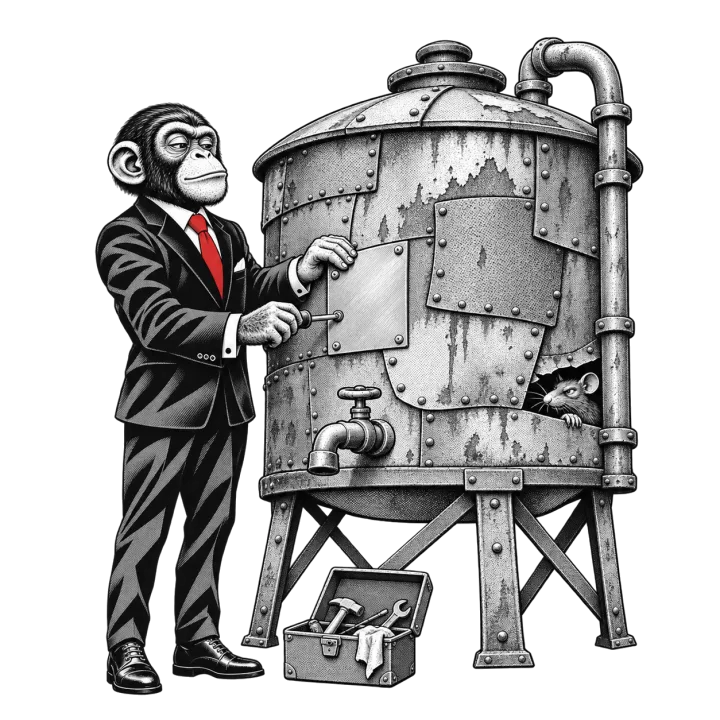
Your website isn’t one single thing. It runs on pieces of software made by others: the content management system (the tool used to edit it, like WordPress), the language it runs on and the server that shows it on the internet. In the last four weeks, five urgent fixes have come out. In the industry they’re called patches: a fix that the software maker publishes when it discovers a flaw. Someone has to install them, and the sooner the better.
What this means for you.
A website nobody maintains can suffer several things. None is certain, all are possible.
The site can stop working. Or it can work for you and show something else to your visitors. In late November, a piece of malicious software was documented that hides inside a website, does nothing when the owner logs in and can redirect visitors to other pages or show them fake warnings. Whoever looks at their own site sees nothing unusual.
Your website’s forms carry your customers' data. If someone gets in, that data may be within their reach.
Then there’s your email. If the domain or the server fails, email on your domain may stop arriving. And if someone uses your server to send spam, your messages may end up in your customers' spam folder.
In business terms: hours or days without receiving enquiries, orders or emails, and the trust of someone who landed on a strange page.
There used to be time to update without rushing, and there is less of it now.
Before, between a flaw being found and someone exploiting it, there was usually time to update without rushing. Now there are programs that look for flaws and exploit them on their own. Google documented it on 16 November 2026: for the first time it has seen attackers automating the whole process, with no person involved.
In July, with a serious WordPress flaw, the first attempts to exploit it were recorded the same day the fix came out. And some of these flaws had been in the software for more than ten years and are only now being found.
Not every website is exposed, and there is still time.
Some only affect websites with a specific configuration, and for several of them no real attacks were known when the fixes were published. That is the window to do things properly, and it is short.
We take care of the technical side.
Maintaining a website means, in plain terms, this:
- Knowing what is installed in each part of the site.
- Installing urgent fixes within hours or days and checking they were applied properly.
- Having backups that have been tested by restoring them.
- Reviewing who holds the access keys and removing the ones no longer needed.
- Watching that the site responds.
- Talking to the hosting company when the problem is theirs.
You don’t need to understand any of this. But for someone to do it every week, it has to be a commissioned, planned job, with hours set aside. It can’t be a favour on the day something breaks.
This reduces risk and reaction time. It doesn’t promise that nothing will ever happen.
Three questions you can ask yourself today.
- Who updates my website, and how often?
- When was a backup last tested?
- Who do I call if the website or email stops working tomorrow?
If you can’t answer one of them, you already know where to start.
Frequently asked questions
Doesn’t my hosting already do this?
Partly. The server, which is the part the hosting company manages, is usually theirs to look after, but it’s worth asking whether they’ve installed the latest fixes and restarted the service. The rest (the content management system, the add-ons and the design of the site) isn’t updated by the hosting company. Whoever maintains the site has to do it.
My website is small, who would be interested?
These programs don’t choose. They automatically go through every website they find and test whether it has the flaw. That’s why the size of the site doesn’t protect it.
My website isn’t WordPress, does it affect me?
It may. Some of the fixes from recent weeks affect pieces of software that many websites use, not only those built with WordPress. It needs checking with whoever manages the server.
I already have automatic updates, isn’t that enough?
They help, but you need to check they actually completed. And they don’t cover every piece. For example, the language or the server aren’t updated by the content management system’s automatic updates.
For anyone who wants the technical detail.
Timeline of the five alerts, with the data as published by the sources in the final list.
- 21 October 2026. PHP publishes emergency updates for two critical flaws (CVE-2026-109618 and CVE-2026-109619), scored 9.2 out of 10 (CVSS v4.0). They are fixed in PHP 8.5.12, 8.4.27, 8.3.36 and 8.2.35.
- 11 November. Apache 2.4.71 fixes a critical flaw in the HTTP/2 module (CVE-2026-119618). It affects versions 2.4.55 to 2.4.70 with HTTP/2 enabled.
- 18 November. NGINX 1.30.7 and 1.31.9 fix two critical HTTP/2 flaws (CVE-2026-123007 and CVE-2026-123633), also scored 9.2 out of 10.
- 18 November. WordPress 7.1.5 fixes 19 vulnerabilities according to Wordfence’s count, one critical and four high, eight without needing authentication.
- 19 November. PHP publishes new critical advisories. The main one is CVE-2026-129289, in PHP-FPM, scored 9.2 out of 10. It is fixed in PHP 8.2.36, 8.3.37, 8.4.28 and 8.5.13.
Where the flaws come from. According to PHP, the vulnerable code in CVE-2026-129289 dates back to PHP 5.6.0, a 2014 release. One of the flaws fixed in WordPress 7.1.5 affects versions from 2.5.0, from 2008. CVE-2026-123007 affects NGINX from 1.9.5, from 2015.
Who is looking for them. According to Wordfence, this November 88% of the reports received by its bounty program are AI-assisted. In April it spoke of a rise from 16% to nearly 66%. Of the more than 16,700 reports received in 2026, about 4,400 have been confirmed as valid vulnerabilities.
Automated attacks. The Google Threat Intelligence Group describes a framework that compares the code before and after each patch, locates the flaw, writes the exploit and runs it on its own. One of the published examples analyses a WordPress plugin. According to the same report, in the PaperCut case (August 2026), security researchers and the company Huntress used AI to generate working exploits within a day of disclosure. On 17 July 2026 the wp2shell patch came out (CVE-2026-60137 and CVE-2026-63030), unauthenticated code execution in the WordPress core, the first critical flaw of this kind in almost a decade according to Wordfence. Wordfence recorded the first probe that same day, at 23:29 UTC.
Exploitation and exposure. For the Apache and NGINX flaws, no real exploitation was known at the date of their advisories (Wiz on 11 November for Apache, CERT-EU on 18 November for NGINX). CVE-2026-129289 was not in CISA’s catalogue of exploited vulnerabilities as of 20 November. The Apache and NGINX flaws require HTTP/2 to be enabled, and the PHP-FPM one requires a specific server configuration.
Layers. According to Wordfence, updating WordPress, plugins, themes or its own product does not fix NGINX, and the PHP flaws belong to the language, not to WordPress. It affects any website running on PHP, Apache or NGINX.
The malicious plugin. On 24 November 2026, Wordfence described a fake plugin that installs itself, most likely after an administrator account is compromised, hides from the plugin list, doesn’t act for logged-in users and runs code in the browser of anonymous visitors. While it is installed, changing passwords or turning on two-factor authentication does not close the door. Wordfence recovered it in two incidents, one in January and one in September 2026. According to Wordfence, its name is generated by an automatic program.
Sources
- Wordfence, 23 Nov 2026: Staying Ahead of the New Threat Landscape in 2027
- Wordfence, 20 Jul 2026: wp2shell Aftermath: The First Critical Unauthenticated WordPress Core RCE in Nearly a Decade
- Wordfence, 21 Oct 2026: Why It’s Urgent to Update PHP on Your WordPress Site: Two Critical PHP Vulnerabilities and What Our Testing Found
- Google Threat Intelligence Group, 16 Nov 2026: GTIG AI Threat Tracker: Agentic Threat Activity Crosses a Significant Threshold
- Wordfence, 24 Nov 2026: Machine-Generated Fake Plugin Turns WordPress Sites Into JavaScript Delivery Points
- Wordfence, 20 Nov 2026: CVE-2026-129289 and Other Critical PHP Vulnerabilities: What WordPress Site Owners Need to Know
- Wordfence, 19 Nov 2026: WordPress 7.1.5 Security Release Fixes 19 Vulnerabilities
- Wordfence, 18 Nov 2026: PSA: Critical NGINX HTTP/2 Vulnerabilities: What WordPress Site Owners Should Know
- Wordfence, 12 Nov 2026: PSA: Critical Apache HTTP/2 Vulnerability: What WordPress Site Owners Should Know
Wordfence sells security products for WordPress, and that is worth bearing in mind when reading its sources.
